FOUNDERS POV
The system I inherited
By Gaia Rialti
07 May 2026
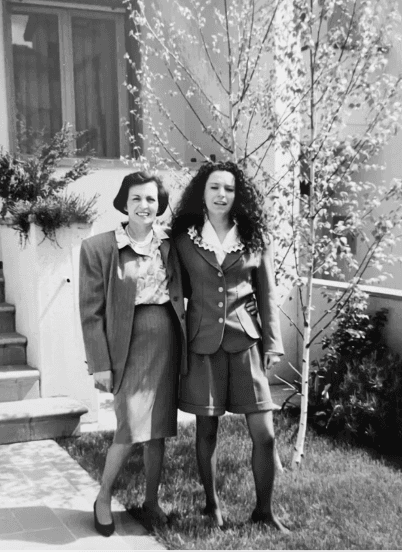
I grew up surrounded by things that were made slowly.
Embroidery on school aprons. A sewing machine always turned on, always in the same room where I did my homework. Balls of wool in every color imaginable. Tablecloths, cushions, fabrics that felt almost excessive in their beauty, all meticulously embroidered, all clearly loved. At the time, I didn’t think of this as “fashion,” or even as creativity. It was simply the environment I grew up in.
My nonna had art inside her long before anyone around her would have called it that. But more than anything, she had a deep passion for what was handmade, unique, and well-made. Quality wasn’t an aesthetic choice, it was a value. Something you could feel in the weight of a fabric, in the precision of a stitch, in the patience it required.
Her relationship with clothes and with objects in general was never about novelty. It was about care, time and about doing things properly. I didn’t know it then, but I was growing up inside a system. A system where nothing was disposable, where repair was normal, and where making something last was not a constraint, but a source of pride.
My mother carried that system forward, but in her own way.
She was always impeccably dressed, always ahead, always curious. She loved fashion in a visible, expressive way. She kept everything not out of nostalgia, but because she knew how to recognize value. She found incredible pieces in flea markets all over Italy, treasures hidden in places most people rushed through. She, too, has art inside her. But hers is broader, more instinctive, driven by passion and appetite; an art that loves excess, experimentation, joy.
My mother and my nonna loved watching runway shows together. They burned through fashion magazines, devoured them. They went shopping together commenting, laughing, observing. And they always did one thing very deliberately: they passed things on. Not just garments, but taste. They never framed what they were doing as sustainability, they never used that word. But sustainability was their quiet superpower, practiced daily and unconsciously. Style, on the other hand, was their distinctive trait.
There are pieces in my mother’s and my nonna’s wardrobes that are still perfectly current today. Clothes with a unique construction, impeccable fabrics, details that feel impossible to reproduce and most importantly: they still work on me.
This is what I mean when I say fashion is a system, not a trend. A system allows things to travel through time, a system adapts bodies, generations, contexts without losing its integrity. Trends don’t do that. Trends ask us to forget.
I remember going to high school with a vintage Burberry bag that belonged to my mother. Everyone else had an Eastpak. That was what was fashionable. I didn’t experience it as rebellion, I just didn’t see why I should replace something that was already right. I was always looking at fashion this way, intuitively. But I didn’t live it fully until the last five years.
Tomorrow I’ll walk through Pitti, the world’s most important men’s fashion fair in Florence. I imagine people walking, talking, gesturing. Fabrics moving with bodies and clothes adapting to weather, to time, to encounters. And yet, I’m still not sure fashion fully reflects the vision I carry with me.
The fashion I search for today is the fashion I learned from my mother and my nonna. A fashion that is real, sincere, unrestrained sometimes excessive. A fashion that dares.
A fashion that isn’t about following rules, but about constructing a world. Fashion needs to be remembered as a system. A system that includes making, wearing, repairing, transforming. A system that values continuity over urgency. One where clothes aren’t endpoints, but starting points. I don’t believe transformation only comes from buying something new. I believe it often comes from staying, from reworking what already exists, from choosing depth over accumulation.
My work today is, in many ways, an attempt to restore that logic. To reconnect fashion with time, with people, with stories; to treat garments not as disposable expressions, but as evolving companions. This isn’t about romanticizing the past. My nonna’s world wasn’t perfect. My mother’s wasn’t either. But there was wisdom embedded in their everyday gestures a wisdom we dismissed too quickly in the rush toward speed.
My nonna didn’t call it fashion. My mother didn’t call it sustainability. I call it a system. One that shaped me long before I had the words for it. One that taught me how to look, how to choose, how to keep. One that I’m still trying, carefully, to carry forward.
And tomorrow, walking through Pitti, surrounded by movement, bodies, and fabric in motion, I’ll be watching for it. Not the next trend but the system still capable of moving with us.
This article was written by Gaia, founder of Menabòh. For more of her writing, follow her personal newsletter on Substack.